

Ponytail Lift in Barcelona
The Ponytail Lift is a facelift technique designed to rejuvenate the middle and upper parts of the face, particularly the forehead, eyebrows, eyes, and cheekbones.
The goal is to reposition the tissues in an upward and slightly posterior direction, aiming for an effect similar to that produced when pulling the hair back into a high ponytail: a more open gaze, a more rested expression, and a sense of facial freshness without losing naturalness.
During your consultation with Dr. Barret, we’ll assess your facial structure, eyebrow position, tissue quality, and degree of sagging to determine whether this technique is appropriate for you. The recommendation must always be tailored to your individual needs, taking into account your expectations and the overall harmony of your face.

- + 25 years of experience
- Specialist Plastic and Reconstructive Surgery
- Inquiry 600 Diagonal Ave., Barcelona
- Personalized Personalized and attentive service
On this page:
Please note
DURATION
3–4 hours
ANESTHESIA
General
INCOME
None or 1 night
INITIAL RECORD
Progressive
OFF TO WORK
2–3 weeks
VISIBLE RESOLUTION
By reducing inflammation
FINAL RESOLUTION
10–12 months
Who Is a Good Candidate for the Ponytail Lift?
The Pony Tail facelift may be recommended for people who are beginning to notice a gradual sagging of the forehead, eyebrows, or cheekbones, as well as a more tired, sad, or even aged appearance.
It may also be considered for patients who wish to open up their eyes and rejuvenate the upper and middle thirds of the face using a less extensive approach than a full facelift.
The suitability of the procedure depends on facial anatomy, tissue position, skin quality, and the desired outcome. For this reason, we conduct an individualized medical evaluation before considering the procedure.
Rejuvenation of the Eyes and Eyebrows
This technique can help lift the upper and outer areas of the eyebrows and improve the appearance of a heavy or dull-looking gaze. The goal is not to change your expression, but to restore a more rested and radiant appearance.
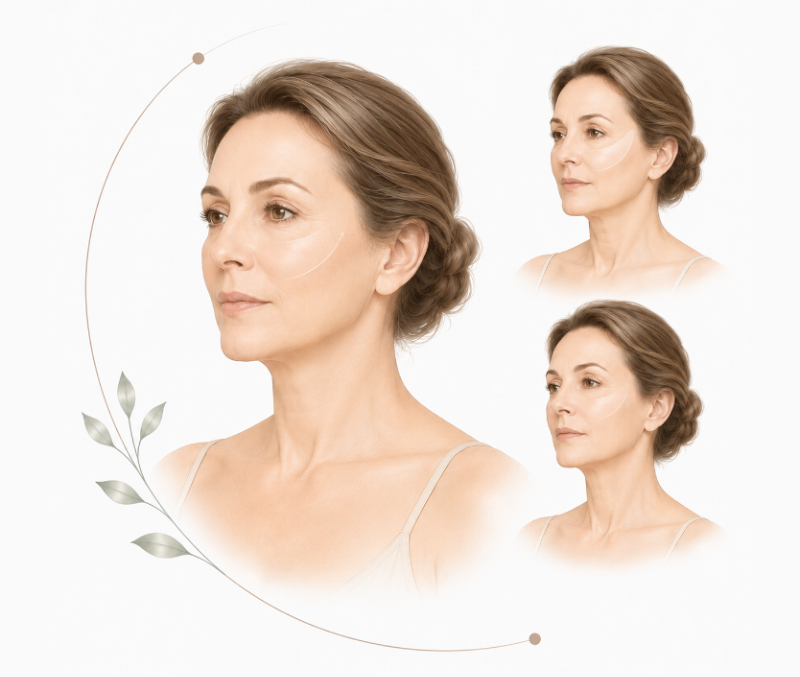
Improvement of the Midface
The ponytail facelift also addresses the cheekbone area and the midface, where sagging tissues can lead to a loss of firmness or a less defined appearance. By repositioning these structures, the goal is to achieve an overall, harmonious improvement.
“Radiance, firmness, and a more alert look. Designed for those seeking a subtle lifting effect that enhances their natural features.”
What Is the Pony Tail Lift?
The Pony Tail Lift combines different facelift techniques into a single procedure to treat the upper and middle thirds of the face in a coordinated manner.
It includes repositioning the forehead (forehead lift), lifting the outer corners of the eyebrows (outer eyebrow lift), and treating the upper third of the face (upper third lift). All of this is performed using a surgical approach focused on mobilizing the deep tissues with the Deep Plane technique, rather than simply tightening the skin.
Unlike treating each area in isolation, this technique aims for a comprehensive treatment of the upper and middle thirds of the face.
This approach allows for a more natural-looking result, preserving facial expression and avoiding an artificial or overly stretched appearance.
The Ponytail Lift: A Natural, Vertical Lift
The direction of repositioning is key. The tissues are repositioned upward and backward, following a vector that promotes a fresher, more open appearance.
The goal is to rejuvenate without altering the patient’s natural features. That is why, during the medical evaluation, we analyze the balance between the eyebrows, forehead, cheekbones, eyes, and facial proportions.
Initial Visit and Personalized Assessment
Every treatment begins with an individualized medical evaluation. During this initial consultation, we’ll listen to your concerns, what you’d like to improve, and your expectations regarding the surgery.
During the visit, Dr. Barret will evaluate your case on an individual basis and explain which options may be right for you. We’ll also discuss the possible limitations of the treatment, the recovery process, and the factors you should be clear about before making a decision.
What happens during the initial assessment?
What treatment options might be appropriate
What results can you reasonably expect?
What the recovery and follow-up process is like
A personalized quote and financing options
How is the Pony Tail Lift performed?
The Pony Tail Lift is performed through small incisions made in the scalp, in areas designed to be concealed by the hair.
Through these incisions, an endoscopic approach is used, which allows for precise visualization and treatment of deep structures. Specifically, the procedure involves working on the superficial layer of skin and fat, as well as the muscle and connective tissue, moving and repositioning them as a single unit.
The procedure is performed under general anesthesia and lasts between 3 and 4 hours. Generally, it requires a 1-day hospital stay, although depending on the case, an outpatient procedure may be possible.
The procedure involves repositioning the tissues of the forehead, the lateral area of the eyebrows, and the midface using the deep-plane technique.
Endoscopic Approach
The use of an endoscope allows surgeons to work through small incisions. This facilitates controlled access to the structures that need to be released and repositioned, while keeping scars in inconspicuous areas of the scalp.
Deep Plane Technique
The Deep Plane approach targets the deeper layers of the face to mobilize tissue as a whole, rather than simply tightening the superficial skin.
This type of approach aims for a more integrated and natural rejuvenation, as it better respects facial dynamics and helps prevent a stiff or expressionless result.
Recovery, Care, and Results
After a Pony Tail facelift, it is common to experience swelling, bruising, and a certain sensation of tightness or altered sensitivity in the treated areas. These changes typically improve gradually over the first few weeks.
Recovery should always follow the surgeon’s instructions, as each case may progress differently depending on the type of procedure, the tissues’ response, and the patient’s usual activity level.
Recovery After a Ponytail Lift
During the first few days, it is recommended to get plenty of rest and avoid strenuous activity. Swelling and bruising may be visible at first, although they usually subside gradually.
Most patients resume their daily activities (except sports) 7–10 days after surgery.
A return to work is usually expected within 2 to 3 weeks, depending on the type of work and the individual’s recovery. Intense physical activities should be avoided during the first few weeks and resumed only when the surgeon gives the go-ahead.
When Will the Final Results Be Visible?
Improvement may begin to be noticeable within the first few days, especially as the swelling subsides, around 2 weeks. Even so, the face continues to change over the course of several months.
The final results are usually assessed between 10 and 12 months, once the tissues have completed their adaptation process and any residual swelling has subsided.

Aftercare Following a Ponytail Lift
After the procedure, it is important to follow medical guidelines and attend the scheduled follow-up appointments.
It’s also a good idea to moisturize your skin during recovery and maintain healthy habits that will help preserve the results over the long term.
In general, the medical team will recommend that you:
-
Keep your head elevated while sleeping.
-
Take your prescribed medication.
-
Apply cold to the affected area.
-
Do not participate in sports during the first few weeks.
-
Avoid strenuous physical activity.
-
Avoid direct sun exposure.
-
Undergo manual lymphatic drainage sessions using the Vodder method to help reduce swelling in the area.
Expected Benefits
A More Open Look
Repositioning the front and sides of the eyebrows can help your eyes appear clearer and more rested.
Rejuvenation of the Upper and Middle Thirds
The treatment can simultaneously improve the forehead, eyebrows, the area around the eyes, and the cheekbones, promoting a fresher appearance.
Discreet Scars
The incisions are made on the scalp, which means that in most cases, the scars are hidden by the hair.
A harmonious and natural result
The goal is to enhance facial expression without altering the face’s identity or creating an artificial appearance.
Combined Treatment of Multiple Areas
By addressing the forehead, eyebrows, and midface in a single procedure, the goal is to achieve a comprehensive and balanced improvement of the upper face.
Risks and Possible Contraindications
Like any surgery, the ponytail lift requires a prior medical evaluation and may be associated with risks or side effects.
Swelling and Bruising
These are common during the first few days or weeks and usually improve gradually over time.
Bleeding or Infection
Although they are uncommon, complications such as bleeding or infection may occur, so it is important to follow the preoperative and postoperative instructions.
Abnormal Scarring
The incisions are usually hidden in the scalp, but scarring can vary from patient to patient.
Asymmetries
The face is not completely symmetrical, and in some cases, small differences between the two sides may persist or appear.
Changes in Sensitivity
A temporary change in sensation may occur in the treated area. This should be monitored during follow-up medical visits.
Not suitable for all patients
Not all patients benefit from this technique. For some people, another type of facelift, an eyelid procedure, or a different approach may be more appropriate.
Frequently Asked Questions
The goal is not to change facial features, but to reposition the tissues to achieve a more rested and natural appearance. The treatment plan must be customized to avoid an unnatural result.
It focuses primarily on the forehead, the outer corners of the eyebrows, the eyes, and the cheekbones. It is a technique that targets the upper and middle thirds of the face.
No. The Pony Tail Lift is not a substitute for a full facelift. It targets specific areas of the face, whereas other facelifts may also treat the neck, jawline, or lower third of the face.
The scars are located on the scalp and are hidden by the hair. Their final appearance will depend on how each patient heals.
Patients usually return to work within 2 to 3 weeks, although this will depend on the type of work and how the postoperative recovery progresses.
Improvement can be seen gradually starting in the first few weeks, but the final result is usually assessed after 10 to 12 months.
In some cases, it can be combined with other facial procedures, but each case must be evaluated individually to avoid unnecessary treatments and ensure a balanced result.
There is no single age. The decision depends more on the position of the tissues, facial anatomy, and the patient’s goals than on a specific age.
Specialist responsible for the treatment
Dr. Joan-Pere Barret
Doctor of Medicine and Surgery · Specialist in Plastic, Aesthetic, and Reconstructive Surgery
License No.: 28191
- Head of the Plastic Surgery and Burns Department at Vall d’Hebron Hospital.
- Director of the Face Transplant Program at Vall d’Hebron University Hospital.
- Plastic Surgeon at Hospital CIMA.
Cost of the surgery
HOW MUCH WILL IT COST ME?
To receive a personalized quote, a preliminary medical evaluation is required. During the consultation, we will explain which treatment is recommended, what results you can expect, and what the recovery process will be like.
FINANCING OPTIONS
If you need to finance your plastic surgery or another cosmetic medical procedure, you can do so easily and conveniently through Tu Medicina Financiada.
You can choose the payment plan that best suits your needs.


Schedule an appointment for an initial evaluation
If you’re thinking about having surgery in Barcelona, the first step is a personalized consultation with a plastic surgery specialist.
During the consultation, you’ll be able to explain what you’d like to improve, ask any questions you may have, and learn which options are best suited to your situation. A personalized treatment plan is essential to achieving the results you desire.

