

Rhinoplasty in Barcelona
Nose surgery to improve facial harmony and, when necessary, respiratory function.
Rhinoplasty allows for the modification of the nose’s shape, size, or structure to achieve a natural, proportionate result tailored to each patient. It can also serve a functional purpose when there are breathing difficulties or internal abnormalities.
A well-balanced nose can subtly alter facial expression. The goal is not to create a “standard” nose, but rather to respect the face’s unique character and to preserve or improve respiratory function when necessary.

- + 25 years of experience
- Specialist plastic and reconstructive surgery
- Inquiry 600 Diagonal Ave., Barcelona
- Personalized Personalized and attentive service
On this page:
Please note
DURATION
2–3 hours
ANESTHESIA
General
INCOME
1 night
OFF TO WORK
1–2 weeks
Who Is a Good Candidate for Rhinoplasty?
Rhinoplasty may be recommended for patients who wish to improve the appearance of their nose, correct issues that affect breathing, or address both concerns in a single procedure. Each case must be evaluated individually, as not all noses require the same technique or the same changes.
For many patients, the decision to undergo rhinoplasty stems from difficulty breathing, a cosmetic concern that has persisted for years, or both. When properly planned, the surgery can improve breathing and personal appearance without altering the essence of the face.
It may be indicated in cases such as:
- A nose that is out of proportion with the rest of the face.
- A visible nasal hump or bridge when viewed in profile.
- A drooping, wide, bulbous, or poorly defined nasal tip.
- A deviated or asymmetrical nose.
- Nose that is too large or too wide.
- Aftereffects of nasal fractures or trauma.
- Difficulty breathing due to anatomical abnormalities.
- Unsatisfactory results from a previous rhinoplasty.
- Desire to achieve a more harmonious and natural-looking nose.

Who is a good candidate?
A good candidate for rhinoplasty is someone who wants to improve the shape or function of their nose, is in good health, and has realistic expectations.
It is also important that facial growth has been completed. In general, rhinoplasty is performed on adults or young patients whose nasal development is already complete.
Before surgery, the patient should understand the procedure, the recovery process, and the limitations of the surgery. Clear communication with the surgeon helps ensure a safe and well-informed decision.
“We don’t aim for a ‘standard’ nose; we prioritize aesthetics and breathing, knowing that each case requires individualized planning.”
What Is Rhinoplasty?
Rhinoplasty is a surgical procedure that reshapes the structures of the nose, such as the nasal bones, cartilage, and soft tissues. Depending on each patient’s needs, it can correct the nasal bridge, reduce a hump, refine the tip, improve symmetry, adjust the width of the nose, or modify the nose’s projection.
However, the nose does not only affect facial aesthetics. It also plays an essential role in breathing. For this reason, before rhinoplasty, we evaluate both the external appearance and the internal structure of the nose.
When there is difficulty breathing, a deviated nasal septum, sequelae from trauma, or internal anatomical abnormalities, surgery can combine both aesthetic and functional goals.
Natural Rhinoplasty: Balance and Proportion
The nose occupies a central position on the face. For this reason, even small changes can have a significant impact on facial harmony. To achieve a natural-looking result, we analyze the nose in relation to the forehead, cheekbones, lips, chin, and jaw.
The goal is not to give every patient the same nose. Each face has its own unique proportions, bone structure, skin thickness, and expression. For this reason, the surgical plan must be tailored to each individual.
- Nasal bridge
- Nasal tip
- Symmetry
- Projection
- Nasal width
- Respiratory function
- Relationship to the chin and facial profile.
- Skin thickness and elasticity
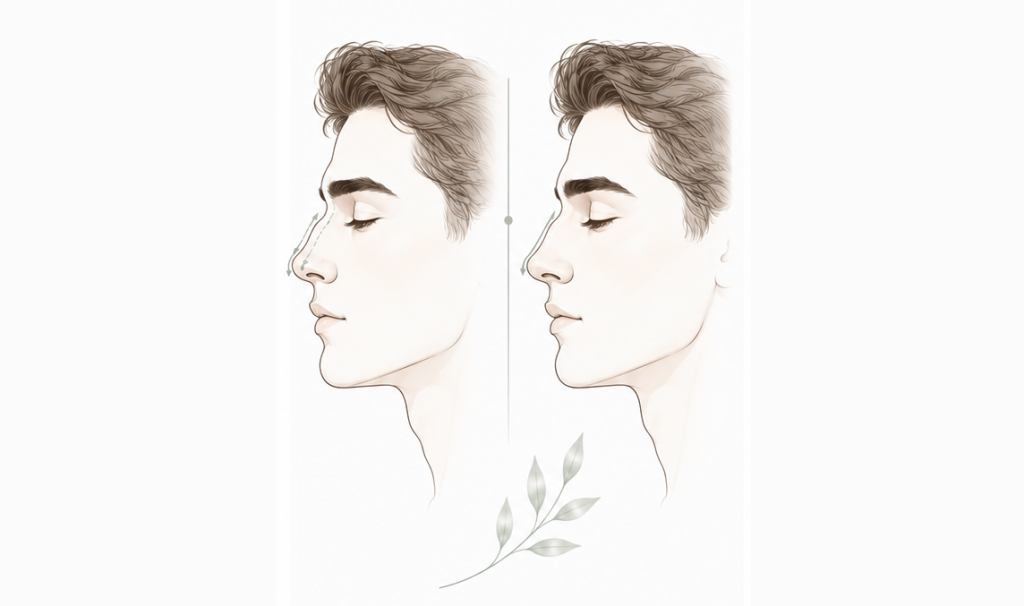
Cosmetic Rhinoplasty and Functional Rhinoplasty: Differences
Cosmetic rhinoplasty focuses on improving the external shape of the nose. It can correct a dorsal hump, smooth the profile, refine the nasal tip, narrow the bridge, or improve the nose’s overall proportion in relation to the face.
Functional rhinoplasty, on the other hand, aims to improve nasal breathing. It may be indicated when there is a deviated septum, collapse of the nasal valves, sequelae of trauma, or structural abnormalities that impede airflow.
When both objectives are combined, the procedure is called rhinoseptoplasty. This procedure allows for the correction of aesthetic issues while simultaneously addressing functional problems related to the nasal septum or the internal structure of the nose.
A well-planned rhinoplasty should not require a choice between aesthetics and function. The goal is to achieve a beautiful, natural, and functional nose.
Initial Visit and Personalized Assessment
Every treatment begins with an individualized medical evaluation. During this initial consultation, we’ll listen to your concerns, what you’d like to improve, and your expectations regarding the surgery.
During the visit, Dr. Barret will evaluate your case on an individual basis and explain which options may be right for you. We’ll also discuss the possible limitations of the treatment, the recovery process, and the factors you should be clear about before making a decision.
What happens during the initial assessment?
What treatment options might be appropriate
What results can you reasonably expect?
What the recovery and follow-up process is like
A personalized quote and financing options
How Is a Rhinoplasty Performed? Surgical Approach Techniques
The technique is determined based on each patient’s anatomy and the goals of the procedure. During the consultation, we will assess whether the rhinoplasty should focus on aesthetics, function, or both.
Closed Rhinoplasty
In closed rhinoplasty, the incisions are made inside the nostrils. This means there are no visible scars on the outside of the nose.
This technique may be appropriate in certain cases, especially when the necessary modifications do not require extensive exposure of the nasal structures. Its main advantage is that it avoids an external scar and may promote a slightly faster recovery in selected patients.
However, not all noses can be treated with closed rhinoplasty. The choice of technique depends on the anatomy, the goals of the surgery, and the complexity of the case.
Open Rhinoplasty
In open rhinoplasty, a small incision is made in the columella, the area between the two nostrils. Through this approach, the surgeon can directly visualize the internal structures of the nose.
This technique is used especially in complex cases, secondary rhinoplasties, significant asymmetries, or surgeries that require detailed work on the nasal tip.
The scar is usually small and, over time, tends to become barely visible. In expert hands, open rhinoplasty yields highly precise and natural-looking results.
Ultrasonic Rhinoplasty vs. Traditional Rhinoplasty
Ultrasonic rhinoplasty is a type of rhinoplasty that uses ultrasonic instruments (a piezoelectric motor) to work on the nasal bones with great precision. It can allow for more controlled incisions and reduce trauma to soft tissues in certain cases.
Ultrasonic rhinoplasty is used in both open and closed rhinoplasty procedures, as well as in secondary and revision rhinoplasty. It is important that the procedure be performed by a plastic surgeon with experience in using the ultrasonic motor in nasal surgery.
Traditional rhinoplasty uses conventional surgical instruments to work on the nasal bone structures. Ultrasonic rhinoplasty, on the other hand, employs ultrasound technology to make more precise incisions in certain cases. The choice between one technique and the other depends on the patient’s anatomy, the goals of the surgery, and the surgeon’s judgment.
Preservation or Conservation Rhinoplasty
Preservation rhinoplasty, also known as conservative rhinoplasty, is a surgical method that focuses on maintaining the original nasal structure as much as possible. Unlike traditional rhinoplasty, which typically involves the resection or removal of nasal cartilage and bone to reshape the nose, preservation rhinoplasty aims to preserve these tissues and strategically reposition them.
Patients who opt for preservation rhinoplasty can expect natural results that harmonize with the rest of the face. Thanks to the preservation of the structures and respect for the original anatomy, the nose retains its unique characteristics and avoids the artificial appearance that sometimes results from more aggressive surgeries.
Secondary or Revision Rhinoplasty
Secondary rhinoplasty is a procedure that corrects or improves the results of a previous rhinoplasty. It may be indicated when the patient is dissatisfied with the aesthetic outcome, when breathing problems persist, or when irregularities have developed following the initial surgery.
This type of rhinoplasty is usually more complex than primary surgery. There may be internal scarring, changes in the cartilage, a lack of structural support, or anatomical changes resulting from the previous procedure.
In some cases, it may be necessary to use rib cartilage grafts or helix (ear) grafts to reconstruct or reinforce certain areas of the nose. For this reason, secondary rhinoplasty requires very careful evaluation and precise planning.
Recovery, Aftercare, and Final Results
Recovery After Rhinoplasty
Recovery from a rhinoplasty is gradual. During the first few days, it is common to experience swelling, nasal congestion, a feeling of pressure, and bruising. These symptoms usually improve gradually.
In general, many patients can resume light daily activities within a few days. A return to work usually occurs within 1 to 2 weeks, depending on the type of work and the individual’s recovery.
During the first few days, the patient wears a nasal splint to protect the operated area. Nasal rinses, medication, and periodic follow-up visits may also be recommended.
Although the nose improves visibly in the first few weeks, it takes longer to see the final result. Residual swelling, especially at the tip of the nose, may take several months to disappear completely.
When will the final results be available?
The results of a rhinoplasty are not immediately apparent. When the splint is removed, the nose already has a new shape, but there is still swelling.
During the first few weeks, the changes are most noticeable. After that, the healing process slows down and the changes become more subtle. The tip of the nose is usually the area that takes the longest to heal, especially in patients with thick skin.
In many cases, the final result becomes apparent between 6 and 12 months after surgery. In complex or revision rhinoplasties, the healing process may be even slower.
That’s why patience is part of the process. A rhinoplasty takes time to settle and reveal its final result.

Post-Rhinoplasty Care
Postoperative care is essential for a successful recovery. Each patient receives personalized instructions, but there are general recommendations that typically apply in most cases.
After rhinoplasty, it is recommended that you:
- Sleep with your head slightly elevated during the first few days.
- Sleep on your back and avoid sleeping on your side for the first few days, following the medical team’s instructions.
- Avoid blows or pressure on your nose.
- Do not exercise until you receive medical clearance.
- Avoid blowing your nose forcefully during the initial phase.
- Do not wear glasses that rest on the bridge of your nose if your surgeon advises against it.
- Avoid direct sun exposure during the first few weeks.
- Do not smoke, as tobacco can affect healing.
- Maintain good nasal hygiene according to medical guidelines.
Expected Benefits of Rhinoplasty
A properly indicated rhinoplasty can improve facial harmony, the shape of the nose, and, in certain cases, respiratory function. The goal is to achieve a natural, well-proportioned result tailored to each patient.
Improving facial proportions.
Rhinoplasty can help balance the nose with the rest of the face, creating a more harmonious and natural appearance.
Correcting a nasal hump.
This procedure allows for the smoothing or reduction of the nasal bridge when it creates an unbalanced profile or one that the patient finds undesirable.
Define the tip of the nose.
You can improve the shape, position, or projection of the nasal tip, always adapting to each person’s anatomy.
Improve nasal breathing.
In functional cases, rhinoplasty can address internal abnormalities that obstruct airflow and affect breathing.
Risks and Possible Contraindications
Although rhinoplasty is carefully planned and performed in a surgical setting, it is still a medical procedure and requires an understanding of its potential risks and limitations.
Prolonged inflammation.
After surgery, swelling may persist for weeks or months, especially at the tip of the nose.
Bleeding or bruising.
As with any surgical procedure, bleeding, bruising, or discomfort may occur during the first few days.
A result different from what was expected.
Even with careful planning, each patient's healing process and response can influence the final outcome.
Need for secondary surgery.
In some cases, a follow-up surgical procedure may be necessary to correct minor irregularities or improve the functional or aesthetic outcome.
Frequently Asked Questions About Rhinoplasty
The perception of pain varies from patient to patient. It is common to experience swelling, pressure, or moderate discomfort during the first few days, which can usually be managed with the prescribed medication.
The procedure usually lasts between 2 and 3 hours, although the duration may vary depending on the complexity of the case and whether an aesthetic, functional, or secondary correction is performed.
Rhinoplasty is performed under general anesthesia, which ensures greater comfort for the patient and a safe surgical environment.
Exercise should be avoided during the first few weeks. Contact sports should be avoided during the first 3 months. The surgeon will determine when it is safe to resume physical activity based on each patient’s progress.
It depends on the technique used. In closed rhinoplasty, the incisions are made inside the nose. In open rhinoplasty, a small scar remains on the columella, which usually becomes less visible over time.
Yes. When there is an anatomical abnormality that impedes airflow, surgery can improve breathing. In these cases, functional rhinoplasty or rhinoseptoplasty may be indicated.
Rhinoplasty changes the shape of the nose. Rhinoseptoplasty combines cosmetic improvement with correction of the nasal septum or other internal structures that affect breathing.
Rhinoplasty can greatly improve facial harmony, but it should not alter the face’s identity. The goal is to achieve a more proportionate and natural-looking nose that functions well for breathing.
Yes, in many cases, a secondary rhinoplasty can be performed. However, it is a more complex surgery that typically requires cartilage grafts and a detailed medical evaluation to assess the actual potential for improvement.
The cost of a rhinoplasty depends on the complexity of the case, the technique required, whether there is a functional component, and whether it is a primary or secondary procedure. To receive a personalized estimate, a medical evaluation is necessary.
Specialist responsible for the treatment
Dr. Joan-Pere Barret
Doctor of Medicine and Surgery · Specialist in Plastic, Aesthetic, and Reconstructive Surgery
License No.: 28191
- Head of the Plastic Surgery and Burns Department at Vall d’Hebron Hospital.
- Director of the Face Transplant Program at Vall d’Hebron University Hospital.
- Plastic Surgeon at Hospital CIMA.
Cost of the surgery
HOW MUCH WILL RHINOPLASTY COST ME?
The cost of a rhinoplasty depends on the complexity of the case, the technique required, whether there is a functional component, and whether it is a primary or secondary procedure. To receive a personalized estimate, a medical evaluation is necessary.
FINANCING OPTIONS
If you need to finance your plastic surgery or another cosmetic medical procedure, you can do so easily and conveniently through Tu Medicina Financiada.
You can choose the payment plan that best suits your needs.


Schedule an appointment for an initial evaluation
If you’re thinking about having surgery in Barcelona, the first step is a personalized consultation with a plastic surgery specialist.
During the consultation, you’ll be able to explain what you’d like to improve, ask any questions you may have, and learn which options are best suited to your situation. A personalized treatment plan is essential to achieving the results you desire.

