

Breast Augmentation in Barcelona
Breast surgery to increase breast volume and improve their shape in a way that is proportionate to your anatomy.
Breast augmentation, also known as augmentation mammoplasty, is a surgical procedure that increases breast size and improves their shape through the placement of breast implants. In select cases, when a small-volume augmentation is desired, the use of the patient’s own fat through lipofilling may also be considered.
Our goal is to plan a surgical procedure tailored to each patient, taking into account body proportions, breast shape, tissue quality, and realistic expectations for the outcome. During the medical evaluation, we will analyze your case and explain which options may be most suitable for you.
- + 25 years of experience
- Specialist Plastic and Reconstructive Surgery
- Inquiry 600 Diagonal Ave., Barcelona
- Personalized Personalized and attentive service
On this page:
Please note
DURATION
1.5–2.5 hours
ANESTHESIA
Deep or General Sedation
INCOME
1 night
OFF TO WORK
1–2 weeks
Who is a good candidate for breast augmentation?
Breast augmentation may be recommended for women who wish to increase breast volume, improve breast shape, or restore some of the volume lost due to physical changes such as pregnancy or weight loss.
It may also be considered in cases of breast asymmetry, when there is a size difference between the two breasts that the patient wishes to correct or improve.
It may be indicated in cases such as:
- Underdeveloped breasts.
- Desire to increase breast volume.
- Asymmetry in breast size.
- Loss of volume or firmness after pregnancy.
- Changes in the breasts following weight loss.
- Desire for a more proportionate body silhouette.

Who is a good candidate?
A good candidate for breast augmentation is a patient in good health with realistic expectations and a clear personal motivation. The decision should be made following an individual medical evaluation, during which we can assess the anatomy of the breast, skin quality, the desired volume, and the most appropriate surgical option.
It’s not just about choosing a size. We’ll evaluate body proportions, the natural shape of the breast, and the result that can be achieved in a safe and personalized manner.
“The goal is not just to increase volume, but to achieve a proportionate, harmonious chest that is tailored to each patient’s anatomy.”
What Is a Breast Augmentation?
Breast augmentation is a surgical procedure designed to increase breast volume and improve breast shape. It is typically performed by inserting a breast implant, although for small-volume augmentations, lipofilling—which uses the patient’s own fat—may be considered.
Planning is an essential part of the procedure. Before surgery, our medical team evaluates each patient’s characteristics to determine the best approach, the type of augmentation, and the most appropriate technique.
The goal is to achieve breasts that are in harmony with the rest of the body, avoiding standardized approaches and prioritizing an individualized medical plan.
Natural Breast Augmentation: Proportion, Shape, and Balance
A natural-looking breast augmentation depends on more than just the chosen volume. To achieve a proportionate result, it is necessary to assess the patient’s anatomy, the initial shape of the breast, the quality of the tissue, and how the breasts relate to the rest of the silhouette.
During the medical evaluation, we will analyze these aspects to guide the surgery toward a harmonious result, avoiding volumes that are unsuitable for each patient’s body structure. The priority is for the augmentation to integrate seamlessly with the figure and meet realistic expectations.
Breast Augmentation with Implants or Lipofilling: Differences
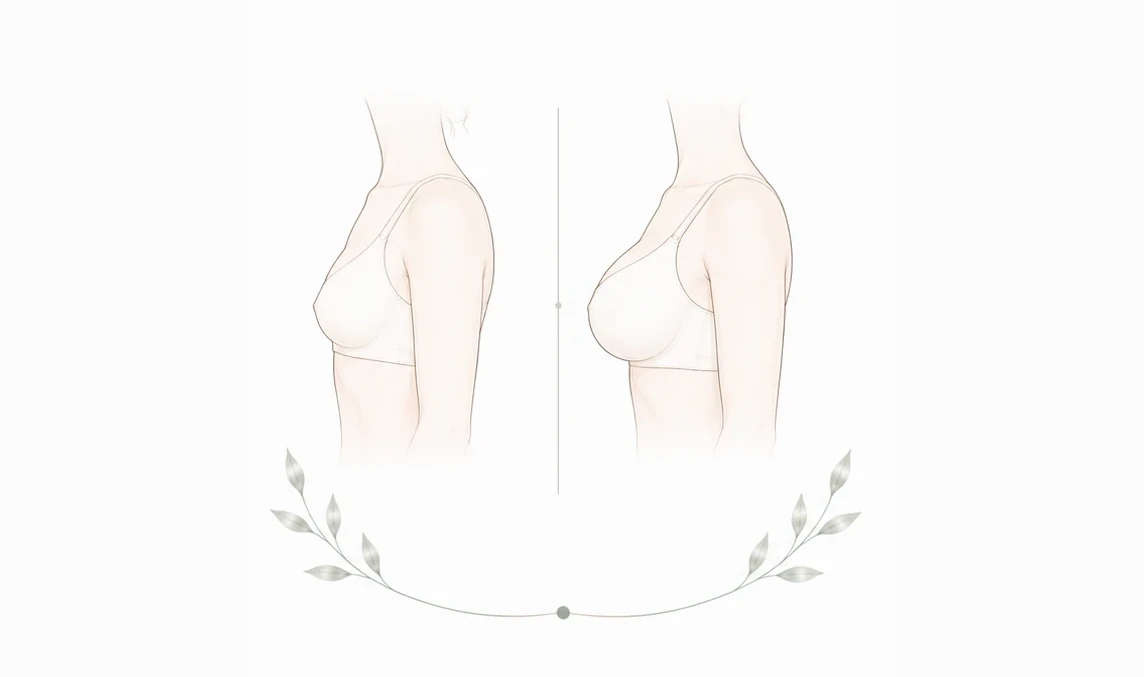
Breast augmentation is typically performed using breast implants, which add volume and reshape the breast according to a planned design. This is usually the primary option when a significant increase in breast size is desired.
In select cases, when a small increase in volume is desired, breast lipofilling may be considered. This technique uses the patient’s own fat to add volume, but not all patients are suitable candidates, and the feasibility depends on the patient’s anatomy, the amount of available fat, and the treatment goal.
During your consultation, we will explain which option may be most appropriate for you and what results you can reasonably expect.
Initial Visit and Personalized Assessment
Every treatment begins with an individualized medical evaluation. During this initial consultation, we’ll listen to your concerns, what you’d like to improve, and your expectations regarding the surgery.
During the visit, Dr. Barret will evaluate your case on an individual basis and explain which options may be right for you. We’ll also discuss the possible limitations of the treatment, the recovery process, and the factors you should be clear about before making a decision.
What happens during the initial assessment?
What treatment options might be appropriate
What results can you reasonably expect?
What the recovery and follow-up process is like
A personalized quote and financing options
How is the procedure performed?
The technique is chosen based on the patient’s anatomy, the desired volume, the shape of the breast, and medical judgment. During the medical evaluation, we will explain which option may be best suited for each case and what expectations are reasonable given the patient’s body structure.
Dual submammary approach
Breast augmentation is typically performed using a dual technique via a submammary incision. This approach allows the implant to be placed through the lower breast crease, an area that facilitates controlled access and precise planning.
Whether this technique is appropriate depends on the patient’s anatomy, the initial shape of the breast, the quality of the tissue, and the desired outcome.
Axillary endoscopic breast augmentation
In certain cases, breast augmentation via an axillary endoscopic approach may also be considered. This technique is performed through small incisions in the armpit area, avoiding a direct incision in the breast crease.
Not all patients are candidates for this approach. Its suitability must be evaluated during a consultation, taking into account the patient’s anatomy, the type of implant, and the goals of the surgery.
Breast lipofilling for small-volume augmentations
When a subtle enhancement is desired, breast lipofilling may be considered. This technique uses the patient’s own fat (from the abdomen or thighs) to add volume, so it requires that sufficient fat be available and that the desired outcome be consistent with a moderate increase in size.
Lipofilling is not always a substitute for implants. It is an option that must be evaluated on a case-by-case basis, depending on the patient’s anatomy, expectations, and the desired volume.
Where are the implants placed?
The exact placement of the implants is determined based on the patient’s anatomy, the desired volume, the shape of the breast, and the patient’s preferences.
Subglandular: The implant is placed beneath the mammary gland, on top of the pectoral muscle. This allows for a faster recovery, but the edges of the implant may be more visible in slender patients.
Subfascial: The implant is placed beneath the prepectoral fascia, creating a protective and camouflaging layer similar to the submuscular plane, but without its disadvantages.
Submuscular: The implant is placed beneath the pectoral muscle, offering a more natural appearance and reducing the risk of certain complications, although recovery is usually slightly longer. In the Dual technique, the implant is placed submuscularly only in the upper portion.
During your consultation, we’ll explain which option may be best for you.
Where are the scars located? Surgical approaches
One of the questions patients ask most often is about the exact location of the scars. In breast augmentation surgery, we distinguish between three types of surgical approaches:
The inframammary approach: This is the most commonly used incision; it is made in the inframammary fold (the crease where the breast meets the chest). It provides direct access to the subglandular or subfascial planes, as well as to the submuscular and dual planes.
The periareolar approach: The incision is made at the base of the areola and also allows access to all three planes. This approach has some disadvantages: during surgery, the surgeon comes into direct contact with the mammary gland, which may result in a loss of sensation in the nipple and areola. This approach is not possible in patients with very small areolas.
The axillary approach is used in cases where the endoscope can be inserted through the armpit. The scar is hidden in one of the folds of the axillary crease, making it virtually undetectable.
During your consultation with the medical team, we will evaluate the indications for breast augmentation, your anatomy, and the type of augmentation to be performed. We will also inform you of the advantages and disadvantages of each approach and which one is most recommended for you.
What types of breast implants are used?
Breast implants are classified based on:
Their shape: round (which add more volume to the upper pole, enhancing and defining the cleavage) and anatomical or teardrop-shaped (which mimic the natural contour of the breast).
Their texture: smooth (with a uniform surface) and microtextured or rough (with a surface designed to reduce the risk of capsular contracture).
The choice of implant type is carefully planned with the patient. It depends on each person’s anatomy, aesthetic goals, and tissue quality.
The 3D simulation with Crisalix helps us evaluate different options for volume and proportion before surgery. During the consultation, we’ll be able to visualize an approximation of the possible outcome and discuss which alternatives best suit your anatomy.
This tool does not replace a medical evaluation or guarantee an exact result, but it can help you better understand the possibilities of breast augmentation and make a more informed decision.
Recovery, Care, and Results
Recovery after breast augmentation is a gradual process, and you should always follow the medical team’s instructions. Every patient heals differently, so follow-up visits are important to monitor the healing process and address any questions during the first few weeks.
Recovery After Breast Augmentation
After the procedure, the patient may need an initial period of relative rest and recovery. It is common to experience swelling, discomfort, and a feeling of tightness, which gradually improve.
Patients typically return to work within 1 to 2 weeks, although this timeframe may vary depending on the type of work, individual recovery, and medical recommendations.
During the first few weeks, it is normal for the breasts to change gradually as the tissues adapt. Therefore, it is important not to judge the results too quickly and to attend all scheduled follow-up appointments.
When can you see the final results of a breast augmentation?
The results of breast augmentation should be evaluated over time. Although the change in volume is noticeable from the start, the shape, position, and integration of the breasts evolve over time.
During your consultation, we will explain the expected process in your case and when a more definitive assessment of the results can be made, taking into account your anatomy, the technique used, and your individual healing process.
It is important to follow your doctor’s instructions, attend all scheduled follow-up appointments, and ask any questions you may have during your recovery.

Post-Breast Augmentation Care
Post-operative care after breast augmentation is tailored to each patient and the specific surgical technique used. The medical team will explain the guidelines you should follow in your case, how to resume your normal activities, and what factors you should keep in mind to ensure proper healing.
In general, we will recommend that you:
- Using a Special Postoperative Bra
- Relative rest
- Do not raise your arms above shoulder level
- Do not lift weights
- Avoid strenuous physical activity and sports for 4 weeks
- Do not drive for 3 weeks
- Take the prescribed medication
Expected Benefits
Increased Breast Volume
This procedure allows for an increase in breast size for patients who desire fuller breasts.
Improving Breast Shape
It can help achieve a more harmonious breast shape that complements the body's silhouette.
Correction or Improvement of Asymmetries
In certain cases, it can help balance out size differences between the two breasts.
Restoring Lost Volume
This procedure may be recommended when the breasts have lost volume due to pregnancy, weight fluctuations, or other physical changes.
Improving Body Image
When appropriate, it can help the patient feel more comfortable with her figure, always within the bounds of realistic expectations.
Risks and Possible Contraindications
Like any surgery, breast augmentation carries certain risks, including:
Infection, bruising or bleeding, capsular contracture (hardening around the implant), implant rupture, changes in nipple sensitivity, and visible or hypertrophic scars.
Choosing the right surgeon and following up closely can reduce these risks.
Realistic Expectations
It is important to understand what can be achieved in each case and what limitations are imposed by the patient’s anatomy.
General Health and Medical History
Prior to the procedure, the patient’s current health status, medical history, and any factors that may influence the surgical indication will be reviewed.
Personalized Selection of the Technique
The surgical approach, implant placement, implant type, and whether to use implants or lipofilling should be determined during the consultation, avoiding decisions based solely on the desired size.
Frequently Asked Questions About Breast Augmentation
It is typically performed using breast implants. For small-volume augmentations, lipofilling using the patient’s own fat may be considered, provided there is an appropriate medical indication.
Breast augmentation is intended to add volume and improve the shape of the breasts. A mastopexy, or breast lift, is recommended when the breasts are sagging and need to be repositioned. In some cases, these procedures can be combined, but each case must be evaluated individually.
It can help correct certain volume asymmetries between the two breasts. The treatment plan will depend on each patient’s anatomy and the extent of the difference.
A return to work usually occurs within 1 to 2 weeks, although this depends on the type of work and each patient’s progress.
The submammary dual technique is commonly used. Depending on the case, an axillary endoscopic approach using small incisions may also be considered.
They do not have an expiration date, although it is recommended to consider replacement after 10 to 15 years. It is important to have checkups to assess the condition of the implants and to see a plastic surgeon if you experience any pain or notice any changes in the shape or firmness of the implant.
Yes, most techniques allow for breastfeeding without any problems.
A natural-looking result depends on proper planning: volume, body proportions, breast shape, tissue quality, and the patient’s expectations. During your consultation, we’ll assess what outcome is realistic for you.
It is advisable to request a consultation when you have a consistent desire to improve the size or shape of your breasts and want to learn about the actual options, limitations, and surgical procedure before making a decision.
Specialist responsible for the treatment
Dr. Joan-Pere Barret
Doctor of Medicine and Surgery · Specialist in Plastic, Aesthetic, and Reconstructive Surgery
License No.: 28191
- Head of the Plastic Surgery and Burns Department at Vall d’Hebron Hospital.
- Director of the Face Transplant Program at Vall d’Hebron University Hospital.
- Plastic Surgeon at Hospital CIMA.
Cost of the surgery
HOW MUCH WILL A BREAST AUGMENTATION COST ME?
To receive a personalized quote, a preliminary medical evaluation is required. During the consultation, we will explain which treatment is recommended, what results you can expect, and what the recovery process will be like.
FINANCING OPTIONS
If you need to finance your plastic surgery or another cosmetic medical procedure, you can do so easily and conveniently through Tu Medicina Financiada.
You can choose the payment plan that best suits your needs.


Schedule an appointment for an initial evaluation
If you’re thinking about having surgery in Barcelona, the first step is a personalized consultation with a plastic surgery specialist.
During the consultation, you’ll be able to explain what you’d like to improve, ask any questions you may have, and learn which options are best suited to your situation. A personalized treatment plan is essential to achieving the results you desire.

