

Full Facelift in Barcelona
Comprehensive facial rejuvenation surgery to treat sagging and signs of aging in various areas of the face and neck.
A full facelift combines different facelift techniques into a single surgical procedure. It may include an endoscopic forehead lift, a mid-face lift, a cervicofacial lift, and a deep-plane lift to comprehensively address the forehead, eyes, cheekbones, lower face, and neck.
Over time, the skin and facial tissues can lose their firmness. Sun exposure, genetics, and daily stress also contribute to the appearance of wrinkles and sagging. During your consultation, we will evaluate your case individually to determine whether a full facelift is the most appropriate option or if a more localized treatment would be better suited.

- + 25 years of experience
- Specialist Plastic and Reconstructive Surgery
- Inquiry 600 Diagonal Ave., Barcelona
- Personalized Personalized and attentive service
On this page:
Please note
DURATION
6–8 hours
ANESTHESIA
General
INCOME
1 or 2 days
OFF TO WORK
2–3 weeks
Who is a good candidate for a full facelift?
A full facelift may be recommended for patients who show signs of aging in various areas of the face, especially when sagging is not limited to a specific region but affects the forehead, eyes, cheekbones, cheeks, jawline, lower face, and neck as a whole.
It is generally recommended for people over the age of 55, although the decision does not depend solely on age. We will assess the degree of sagging, the quality of the tissues, the patient’s expectations, and their overall health before recommending any procedure.
A medical evaluation is essential to determine whether surgery is appropriate in each case. Not all patients have the same degree of sagging, nor do they all require the same surgical approach.
It may be indicated in cases such as:
-
Visible sagging in various areas of the face.
-
Overall aged appearance.
-
Loss of facial and neck definition.
-
The need to treat the forehead, midface, lower face, and neck as a whole.
-
Patients who wish to rejuvenate their appearance through a comprehensive surgical plan.
-
Cases in which a localized or partial facelift may be insufficient.

Who is a good candidate?
A good candidate for a full facelift is someone who wishes to improve the overall appearance of the face and neck, is in good enough health to undergo surgery, and has realistic expectations.
During the medical evaluation, we will determine whether the procedure should be performed on its own or in combination with other procedures, such as blepharoplasty or lipofilling, when indicated to achieve the best overall result. The recommendation must always be tailored to each patient’s anatomy and needs.
“The goal is not to change your expression, but to rejuvenate your face in a comprehensive, harmonious way that respects your facial identity.”
What Is a Full Facelift?
A full facelift is a surgical procedure that combines different types of facelifts into a single operation. Its goal is to treat facial aging comprehensively, addressing different areas of the face and neck when sagging or loosening occurs in multiple areas.
Unlike a localized or partial facelift, which focuses on a specific region, a full facelift allows for a more comprehensive correction. During your consultation, we will assess which areas require treatment and determine the most appropriate combination of techniques.
The techniques used will depend on the signs of aging you wish to treat. Generally speaking, it involves a combination of endoscopic techniques, skin repositioning, and deep-plane techniques to achieve a natural-looking facial rejuvenation while preserving your unique features and natural appearance.
Full Facelift: Comprehensive Facial Rejuvenation
The face ages in three dimensions. The forehead, eyes, cheekbones, cheeks, jawline, and neck can change gradually—and not always at the same rate. Therefore, when aging affects multiple areas, a comprehensive approach may be necessary.
The goal of a full facelift is not to alter facial expressions or create an artificial result—quite the opposite.
The total facelift embodies the essence of facial rejuvenation: an anatomical assessment of the face, the expression of emotions, and a comprehensive evaluation of the signs of facial aging, all within a holistic approach.
Through this comprehensive assessment, we determine which signs of aging should be treated to achieve a harmonious and natural result that enhances the beauty of each individual’s face.
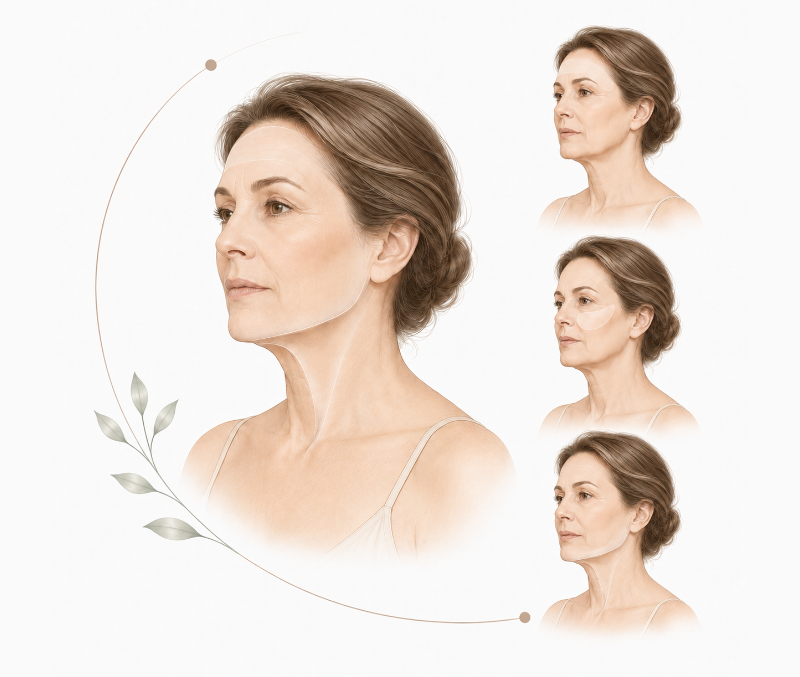
Full Facelift vs. Localized Facelift: Differences
A localized or partial facelift focuses on a specific area, such as the forehead, the midface, or the cervicofacial region. It may be sufficient when signs of aging are concentrated in a single area.
A full facelift, on the other hand, is considered when the entire face appears aged. In these cases, treating only one area may not provide adequate balance, so a combined procedure is recommended to achieve a more harmonious rejuvenation.
Initial Visit and Personalized Assessment
Every treatment begins with an individualized medical evaluation. During this initial consultation, we’ll listen to your concerns, what you’d like to improve, and your expectations regarding the surgery.
During the visit, Dr. Barret will evaluate your case on an individual basis and explain which options may be right for you. We’ll also discuss the possible limitations of the treatment, the recovery process, and the factors you should be clear about before making a decision.
What happens during the initial assessment?
What treatment options might be appropriate
What results can you reasonably expect?
What the recovery and follow-up process is like
A personalized quote and financing options
How is a full facelift performed?
The procedure is customized based on the patient’s anatomy, the degree of sagging, and the areas requiring treatment. A full facelift may combine an endoscopic forehead lift, a mid-face lift, and a cervicofacial lift and/or deep-plane lift in a single surgical procedure.
Our medical team will also assess whether it is appropriate to combine other procedures, such as blepharoplasty or lipofilling, to complement the treatment when medically indicated.
Combination of Facelift Techniques
A full facelift may involve several procedures:
Endoscopic forehead lift, which targets the upper part of the face.
Endoscopic mid-face lift , focusing on the cheekbones, upper cheeks, and the area around the eyes.
Cervicofacial facelift targeting the lower face and neck.
This combination of facelifts performed using different techniques, including the Deep-Plane technique, allows for the treatment of different areas within a single surgical plan, avoiding a piecemeal approach to facial aging when the case requires a comprehensive strategy.
Full facelift with blepharoplasty or lipofilling
In some patients, a full facelift may be combined with blepharoplasty and/or lipofilling to achieve the desired result. Blepharoplasty can help treat excess skin or bags under the eyes, while lipofilling may be part of a more comprehensive facial treatment plan when the medical team deems it appropriate.
These procedures are not automatically recommended. The decision is made after evaluating the patient’s facial structure, eye appearance, skin quality, and goals.
Where are the scars located?
The incisions are usually strategically placed to minimize their visibility.
They are usually made on the scalp in the temporal and central areas of the head, along the hairline near the sideburns, and around the ear.
In some cases, additional incisions may be made under the chin to treat the neck area.
Recovery, Care, and Results
Recovery after a full facelift should be viewed as a gradual process. Since this is a comprehensive procedure, medical follow-up is important to monitor progress and address any concerns at each stage.
Recovery from a full facelift usually takes several weeks, but most patients can resume their daily activities (except for strenuous exercise and sports) within 10 to 15 days.
Before surgery, we’ll explain how to prepare, what aftercare instructions to follow, and when you can resume your normal activities based on your specific situation.
Recovery After a Full Facelift
Patients typically return to work within 2 to 3 weeks. This timeframe may vary depending on the individual’s recovery, the type of work, and whether the procedure was combined with other treatments.
During the first few weeks, it is common for patients to need to adjust their daily routine and follow the medical team’s instructions. At follow-up visits, we will assess the healing of the tissues and the recovery process.
When Are the Results of a Full Facelift Visible?
The results of a full facelift become apparent gradually. At first, the tissues need time to settle, and the swelling must subside. For this reason, the results should be evaluated with caution and as part of your follow-up care.
The first results become visible after 2 or 3 weeks, once the swelling has subsided considerably. However, as with any other facelift procedure, the final assessment of the results should be made after 9–12 months.
It is important not to rush to conclusions or interpret the final result too soon.
The goal is to achieve an overall improvement in the face and neck, resulting in a rejuvenated appearance that is consistent with the patient’s facial identity.

Aftercare Following a Full Facelift
After the procedure, we will provide you with personalized postoperative instructions. These recommendations may include guidelines on rest, hygiene, follow-up visits, a gradual return to activity, and specific care depending on the technique used.
It is important to follow your doctor’s instructions and attend follow-up appointments to assess your recovery and identify any issues that require monitoring.
Care is tailored to each individual case.
In general, after surgery, it is important to follow these guidelines:
Get plenty of rest during the first few days.
Sleep with your head elevated to reduce swelling.
Eat a soft diet or foods that are easy to chew.
Take your prescribed medication.
It is essential to keep the incisions clean.
Avoid physical exertion for at least 3 weeks.
Undergo Vodder and Indiba® manual lymphatic drainage sessions to help reduce swelling more quickly.
Scars should be protected from the sun to prevent pigmentation and promote better healing.
Expected Benefits
Overall Improvement in Facial Appearance
A full facelift allows for the treatment of different areas of the face and neck within a single surgical plan.
Harmonious Rejuvenation
By treating several areas at once, it can help achieve a more balanced improvement when aging affects the entire face.
Recovery of Identity and Body Image
The goal is for the patient to be able to recognize themselves with a more relaxed appearance that matches how they feel.
Boosting Self-Esteem
Improving one’s facial appearance can have a positive impact on self-confidence, provided expectations remain realistic.
Can be combined with other procedures
In select cases, it can be combined with blepharoplasty and/or lipofilling to complete the facial contouring plan.
Risks and Possible Contraindications
Like any surgical procedure, a full facelift requires a prior medical evaluation, appropriate medical indication, and postoperative follow-up.
The most common risks include:
- Bruising or postoperative bleeding.
- Infection in the operated area.
- Visible or abnormal scars.
- Temporary or permanent nerve damage.
- Temporary or permanent hair loss at the scalp incision sites.
- Facial asymmetry.
It is essential to consult an experienced plastic surgeon, follow all pre- and postoperative instructions, and report any unusual symptoms during recovery.
Overall Health Status
Before recommending surgery, we will evaluate your medical history, medications, lifestyle habits, and any other factors that may affect the safety of the procedure.
Realistic Expectations
A full facelift can improve the overall appearance of the face, but it should not be viewed as a complete transformation or as a guarantee of a specific result.
Alternatives or More Targeted Treatments
In some cases, a specific facelift—such as a cervicofacial lift, a mid-face lift, or a forehead lift—may be preferable to a comprehensive procedure.
Frequently Asked Questions About a Full Facelift
It is a surgical procedure that combines different types of facelifts to comprehensively address aging in various areas of the face and neck.
It is generally recommended for people over the age of 55, although age is not the only criterion. The decision depends on the degree of sagging, the quality of the tissues, and the patient’s overall health.
A cervicofacial lift focuses primarily on the lower part of the face and the neck. A full facelift takes a more comprehensive approach to the face, combining different techniques when aging affects multiple areas of the face.
Yes. In some cases, a full facelift can be combined with blepharoplasty to complete the rejuvenation of the eyes. The decision to proceed is made following an individual evaluation.
The treatment plan should aim for a natural improvement that respects the patient’s facial identity. During your consultation, we will discuss what changes are reasonable and what results you can expect in your case.
The return to work usually takes between 2 and 3 weeks, depending on the individual’s recovery and the type of work.
Yes. A full facelift requires a 1- or 2-day hospital stay.
The best way to find out is through a medical evaluation. If aging affects a specific area, a localized or partial facelift may be sufficient. If it affects the entire face, a full facelift may be considered.
Specialist responsible for the treatment
Dr. Joan-Pere Barret
Doctor of Medicine and Surgery · Specialist in Plastic, Aesthetic, and Reconstructive Surgery
License No.: 28191
- Head of the Plastic Surgery and Burns Department at Vall d’Hebron Hospital.
- Director of the Face Transplant Program at Vall d’Hebron University Hospital.
- Plastic Surgeon at Hospital CIMA.
Cost of the surgery
HOW MUCH WILL IT COST ME?
To receive a personalized quote, a preliminary medical evaluation is required. During the consultation, we will explain which treatment is recommended, what results you can expect, and what the recovery process will be like.
FINANCING OPTIONS
If you need to finance your plastic surgery or another cosmetic medical procedure, you can do so easily and conveniently through Tu Medicina Financiada.
You can choose the payment plan that best suits your needs.


Schedule an appointment for an initial evaluation
If you’re thinking about having surgery in Barcelona, the first step is a personalized consultation with a plastic surgery specialist.
During the consultation, you’ll be able to explain what you’d like to improve, ask any questions you may have, and learn which options are best suited to your situation. A personalized treatment plan is essential to achieving the results you desire.

